The robot revolution is gaining momentum: will Figure 03 survive its own success?
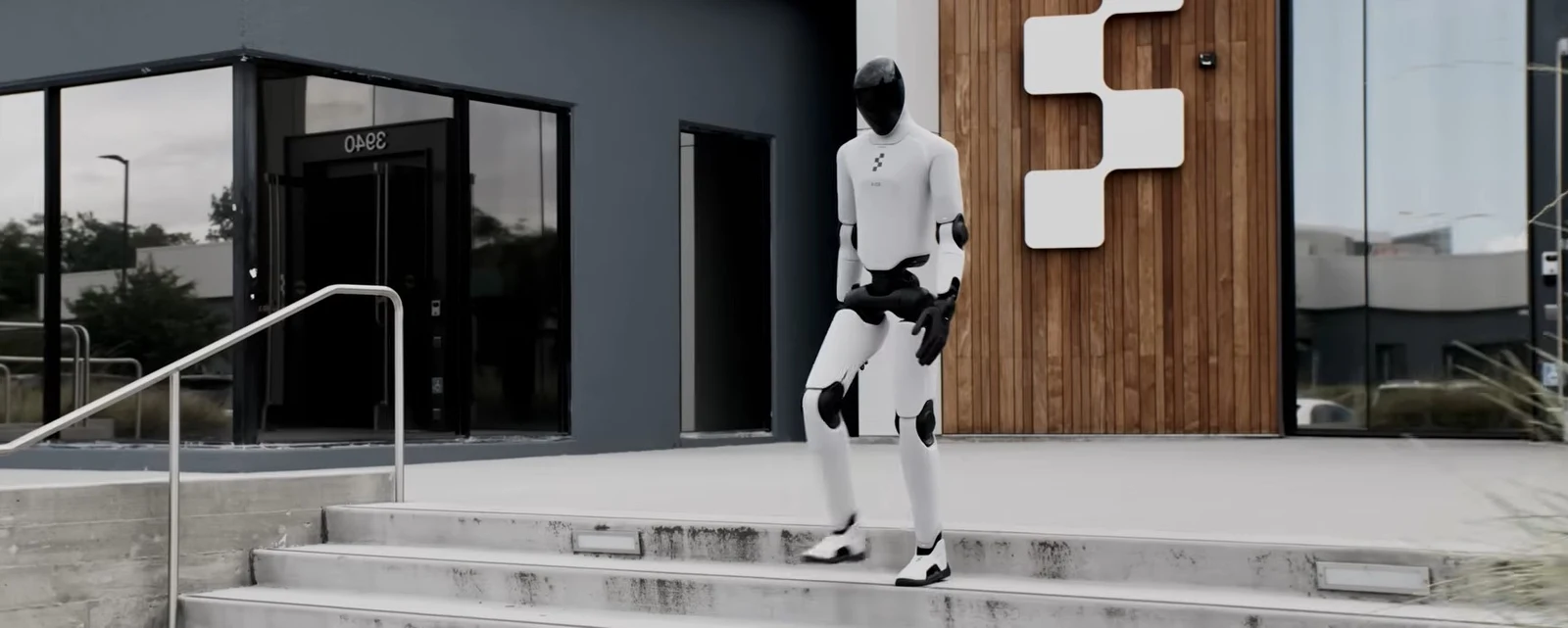
English translation from Unibot. Source published 2026-05-14.
The race for a “world without work” has officially moved from the laboratory to the factory level. As of May 2026, two industry titans—Figure AI and 1X Technologies—have achieved their promised goal: mass production.
The transformation at BotQ's San Jose plant is astonishing. In just the last 120 days, the company has increased its throughput 24 times. What used to be one robot per day has grown to one robot per hour. This week alone, the plant plans to assemble 55 humanoids, bringing its total supply above 400 units.
At the same time, 1X Technologies officially launched its NEO Factory in Hayward. Production has been ramping up since April, and 1X is sticking to its promise of delivering the first consumer NEOs by the end of 2026. This dynamic is not limited to the Western market - global players such as Agibot (which recently opened an AI World Experience Center in Malaysia) and Unitree are already shipping thousands of devices, and Agibot crossed the 10,000 robot mark in March this year.
But when thousands of humanoids begin to roll off the assembly line, a pressing question will arise: what will happen to them when a new generation appears? Will that $20,000 investment be withdrawn, written off, or left to languish as outdated relics?
The Myth of “Writing Off”: Lessons Figure 02
To understand the future, we need to look back at the recent past. At the end of 2025, Figure officially retired the F.02 fleet after 11 months of operation at BMW's Spartenburg plant. Although the word “write-off” may sound like a failure, it was in fact a strategic end to a phase.
F.02 was not written off because it stopped functioning - it was written off because it completed the “data saturation” task. The reasons were threefold:
Hardware wear testing: F.02s have logged approximately 200 miles and contributed to the assembly of 30,000 vehicles. These "battle scars" revealed critical hardware failure points (such as electronics in the wrists and problems with heat dissipation from the motors), which were directly used in the redesign of the Figure 03 design.
Collecting edge cases: The robots were taken out of service once Figure had accumulated enough failure data to train the next version of the Helix model.
Prototype vs Product: F.02 was a test piece. The Figure 03 is the first machine designed for mass market service and durability.
Common industry problem
This "upgrade anxiety" isn't unique to Figure. It applies to 1X, Tesla, Agibot, and Unitree. As equipment life cycles accelerate, manufacturers are increasingly adopting the “silicon-water-valley” logic in relation to heavy machines.
Trade-in hypothesis (Apple model)
Humanoids have a lot of expensive components - specialized drives, proprietary batteries and advanced sensors. It looks very likely that manufacturers will be offering "cycle upgrade" programs. Just like trading in an iPhone, owners will be able to trade in a Figure 03 or 1X NEO and receive a significant credit towards the next model.
Refurbished Device Market: These “recommissioned” machines can be sent back to factories like BotQ or NEO Factory for refurbishment and sold on secondary markets (to schools, small labs or hobbyists) as “certified used”, enabling a circular economy.
One brain, many bodies: software continuity
Universal Brains
Since models like Figure's Helix 02 or 1X's World Models are neural architectures, the "skill" learned by Figure 04 can be compressed and transferred to Figure 03 via over-the-air updating.
Fleet Synergy
In the future, you won't just have the "newest" robot in your home or factory. You'll likely be managing a heterogeneous fleet, with the older Figure 03 handling heavy repetitive tasks and the newer Figure 04 high-precision operations, with both robots sharing a common local map and user profile.
Legacy of Intelligence
We are moving away from the era of “disposable” technology. With modular bodies, replaceable assemblies, and cloud-based intelligence, the current generation of mass-produced humanoids are designed to last.
Whether you trade it for the next generation or keep it as a reliable worker, the Figure 03 or 1X NEO is not just a robot, it is the start of a decade-long partnership in embodied AI.