The University of Queensland created cyborg cockroaches to save people
English translation from Unibot. Source published 2026-08-27.
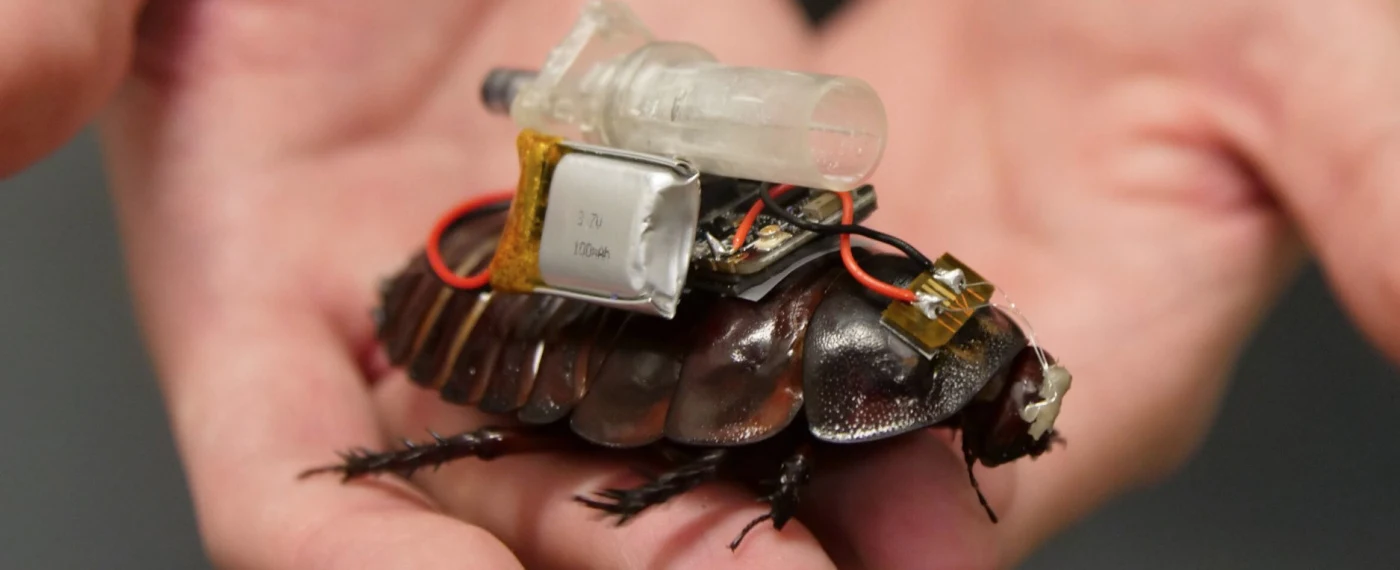
Researchers at the University of Queensland have transformed giant burrowing cockroaches into cyborg paramedics. Swarms of such insects with cameras and miniature injectors could deliver emergency aid to people trapped in collapsed buildings or caves.
From exploration to rescue
"Paraborgs", created by UQ bionicists and engineers from the University of New South Wales, take insect cyborgs beyond simply searching for survivors. Now they are actively helping them. The study was published in the journal Advanced Science.
UQ bionics engineer Dr Thang Vo-Doan says their work transforms the cyborg insect from a mobile sensor into a tiny rescue platform. Key medical decisions remain with a human.
“For the last couple of decades, insect cyborgs have been designed for search and reconnaissance missions,” says Vo-Doan. - We wanted to take the next step. When they find a person, can they really help?”
Why the giant burrowing cockroach
The researchers equipped the insects with lightweight electronics, cameras for visual feedback, and remotely activated auto-injection systems made specifically for this species. The giant burrowing cockroach has a greater carrying capacity to carry specialized rescue and medical equipment.
“By complementing their natural biomechanics, we can enable these cyborg insects to provide timely emergency assistance when direct access to people trapped in narrow rubble is not possible,” explains Vo-Doan.
Injection accuracy
In proof of concept testing, paraborgs showed a 95% success rate when injected at close range - within fifteen centimeters of the target. The complete navigation plus injection task was performed successfully 72% of the time.
Graduate student Hai Nhan Le says that accurately positioning the paraborgs was one of the key engineering challenges.
“The cyborg insect needs to reach the target, position itself accurately, and remain stable enough to deliver the injection,” explains Le.
"Many people might not like the sight of a giant cockroach running towards them, but if you're stuck under rubble or in a cave and need help, it could be the real difference between life and death."
Ethics and biomedical potential
Director of the UNSW Medical Robotics Laboratory Associate Professor Thanh Nho Do says paraborg technology could expand the reach of emergency medicine. The cockroaches, like the team's previous cyborg insect models, are under anesthesia during the installation of electrodes and microchips, and after removing the strapping they live as long as ordinary cockroaches.
“From a biomedical perspective, the opportunity is to bring treatment to the patient when the patient cannot yet be brought to treatment,” says Do.
“The long-term goal is targeted, human-controlled intervention in places inaccessible to conventional medical technologies.”
Adaptation for different types
Vo-Doan says the research demonstrates the ability of UQ's bionics lab to adapt cyborg technology to different insect species. The team has previously shown cyborg beetles that can climb in a controlled manner, and larger cockroaches provide greater carrying capacity for specialized equipment.
“Instead of building one robot that does everything, we can use the natural strengths of different insects and equip them for different missions,” says Vo-Doan.
Superintendent Tim Hassiotis, head of natural disasters and humanitarian response at Fire and Rescue NSW, says technology can enhance the capabilities of rescue teams.
“If cyborg insects can safely enter places we can't, find victims, and ultimately help deliver emergency aid, they could be another valuable tool in the future of urban search and rescue,” Hassiotis concludes.
Swarm with specialized roles
Vo-Doan noted that in the future it is planned to use swarms of cyborg insects, where each individual performs its own function.
“Some may carry cameras and environmental sensors, others may carry specialized emergency or medical equipment,” he explained.
“We are not looking to replace rescue workers, but to give them an additional way to see, reach and possibly help people when direct access is not possible.”
“We hope that in the next 5 to 10 years, teams of insect cyborgs will be able to participate in real life rescue missions if we have the resources to speed up research and field testing.”