Tiangong Ultra breaks Usain Bolt's 100m record
English translation from Unibot. Source published 2026-08-24.
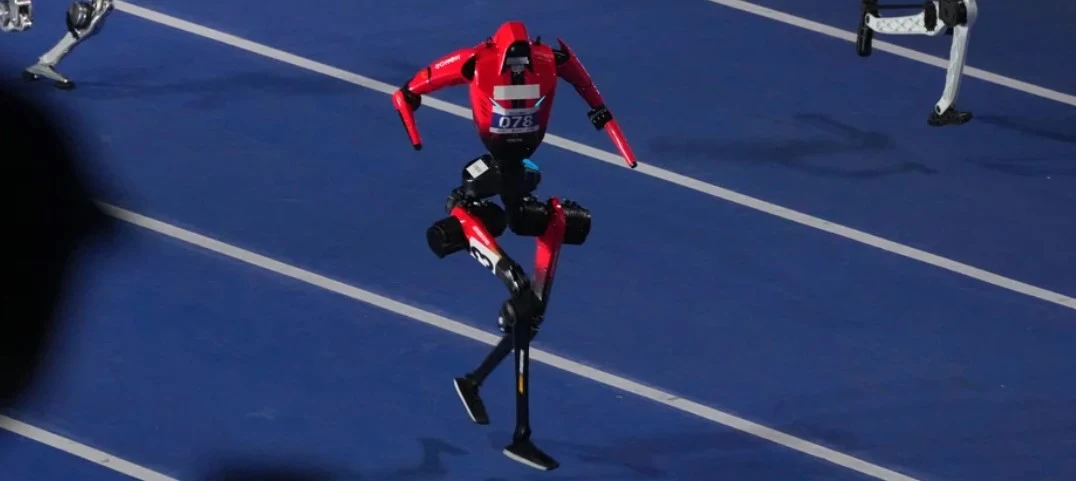
Tiangong Ultra won the 100m preliminary heat at the World Humanoid Robot Games in Beijing. Time - 9.39 seconds. The robot was developed by the Beijing Humanoid Robot Innovation Center, operating under the X-Humanoid brand.
At the finish line, it overtook the Lightning robot from Honor, although it had initially trailed.
Race results
Lightning finished in 9.47 seconds, and the robot from Unitree Robotics came third with a result of 12.41 seconds. Both leaders clocked times faster than Usain Bolt's 100m world record of 9.58 seconds, set in 2009.
True, these results cannot be compared directly with track and field records: the details of timing, start procedures and control of robots are unknown. The three-second difference between first and third place also shows how unevenly developed the running technique is between different teams.
Key figures
Tiangong Ultra time: 9.39 seconds
Lightning time: 9.47 seconds
Unitree robot time: 12.41 seconds
Tiangong Ultra's previous winning time: 21.50 seconds
Lightning peak speed in tests: 14.5 meters per second
X-Humanoid robot high jump: 2.88 meters
Huge progress in a year
The most revealing comparison is with Tiangong Ultra’s own result at the previous Games. Last year its winning time was 21.50 seconds. That is, the new race improved the result by more than twelve seconds.
Chinese state media also reported that Lightning ran the 100-meter dash in 9.32 seconds in a preparatory test, reaching a speed of 14.5 meters per second. Reuters provided this data, but did not specify the measurement methodology.
Before the Games, Lightning researchers seriously changed the geometry of the robot. At the recent half-marathon of humanoid robots, it was 169 cm tall with 95 cm legs. Then, according to CCTV, the legs were lengthened by 10 cm - to 1.05 meters.
Another robot, X-Humanoid, jumped 2.88 meters at the same Games, reports CBS News. For comparison, the human record is 2.45 meters, set by Javier Sotomayor in 1993. The reports do not specify whether the robot was jumping from a standing start or from a running start, so these figures are not directly comparable.
Speed ahead of braking
The finish exposed a weak spot. Both robots did not brake under control, but crashed into thick mats placed for stopping. Tiangong Ultra stumbled and went to the side, and Lightning completely collapsed - it was carried away on a stretcher.
Sprint results show rapid progress in straight line running, but controlled deceleration was not included in the results demonstrated. But braking is a key part of safe high-speed movement among people and industrial equipment.
What's missing from the reports?
None of the reports names the exact configuration of the robots in the race: neither dimensions, nor power characteristics, nor the degree of autonomy, nor the timing method, nor the start procedure. Without these details, the result should be taken as the result of the competition, and not as a reproducible technical indicator.
By the way, Lightning previously won this year's Humanoid Robot Half Marathon with a time of 50 minutes 26 seconds. Tiangong Ultra won the last edition of this distance.
The Beijing Games opened on August 22, 2026, and include 51 disciplines: football, table tennis, dance and industrial challenges. Organizers said 2,056 robots from 666 teams from 16 countries and six continents are participating. For comparison, there were 280 teams at the previous Games.
The reliability of the participants left much to be desired, with CBS reporting robots that stumbled, fell apart, and even caught fire. The competition will run until Wednesday 26 August at the National Speed Skating Oval in Beijing.