Tokyo Humanoids Summit showcases dexterity and delivery robots
English translation from Unibot. Source published 2026-06-01.
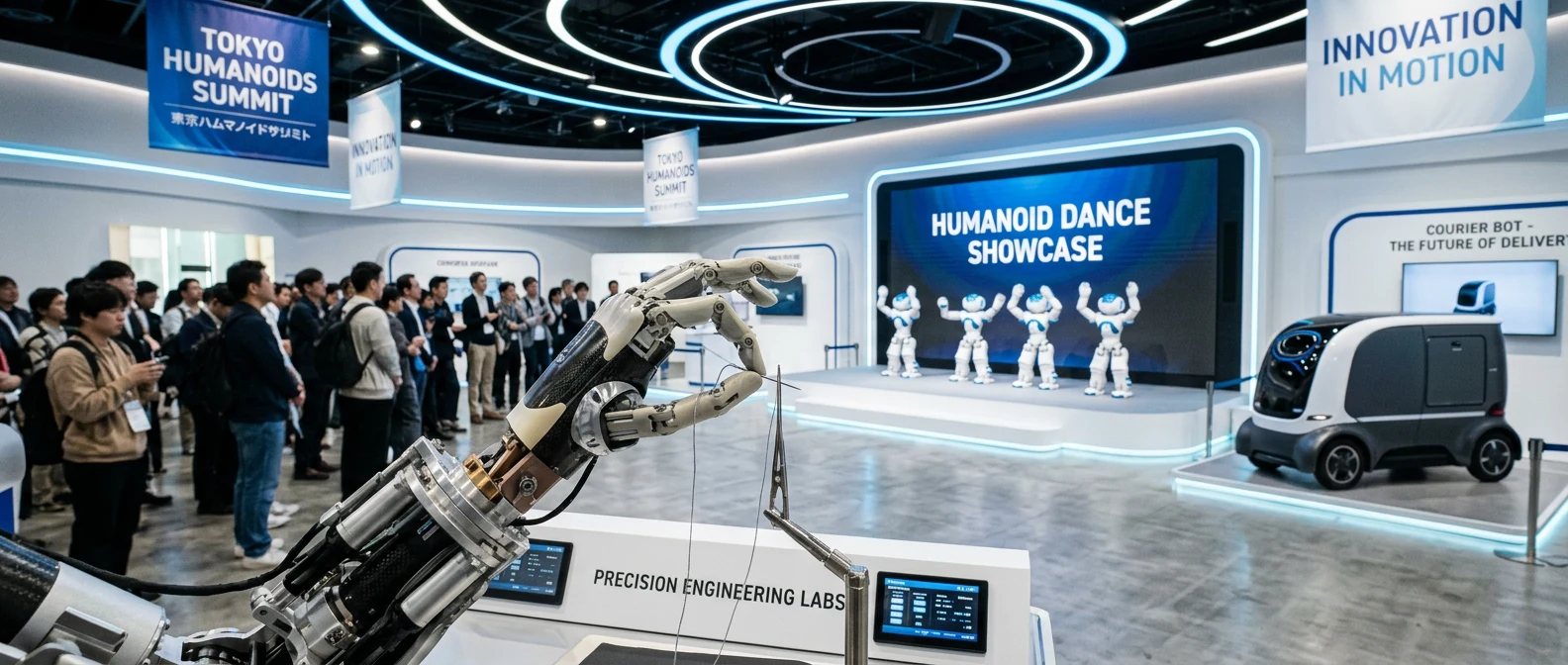
The Tokyo Humanoids Summit put manual dexterity and labor-oriented application on the same stage. According to AP News, at an event in Tokyo, developers showed off robotic arms that are credited with the precision needed to thread a needle; humanoids of childish height who performed dances; as well as full-size vehicles positioned as future couriers.
Tokyo Humanoids Summit: Focus on Agility
The most obvious technical message of the exhibition was that manipulation is taking center stage. A mechanical arm that is claimed to be able to thread the eye of a needle is a familiar statement in robotics at the summit, but it also points to a real bottleneck: humanoids are only as useful as their arms, when tasks require fine contact, orientation control, and repeatability of actions.
This is important because evaluations of humanoid robotics have often begun with measures of locomotion and stability. The Tokyo show offered a broader benchmark, combining core control with hand capabilities. Even in a brief overview of the event, the emphasis on manual skills stood out next to more visible demonstrations, such as dances, which are easier to recognize by a general audience, but which involve less hands-on work.
The variety of exhibits also reflected the current diversity of the industry. The AP describes child-like dancing robots and full-size delivery systems, demonstrating that participants continue to experience multiple roles for humanoid platforms, from expressive public interaction to hands-on cargo handling.
This mix is important because it shows that the category has not yet converged on a single product profile. Some developers are still using motion and behavior demos to demonstrate control quality and stability, while others are moving towards production scenarios where value comes from reliability rather than performance.
Focus on workforce shapes Tokyo Humanoids summit
AP's narrative portrayed robots as a future part of the workforce, not just as research prototypes or entertainment devices. This distinction is important for operators and technical customers because it shifts the focus from individual demonstration points to questions that the source does not yet answer: task cycle times, uptime, supervisory load, and the ability of these machines to consistently perform useful work in a human home environment.
Delivery assistance is a case in point. For humanoids, this is a relatively specific story because buildings, doors, carts, shelving, and hallways are already designed for human height and reach. The full-sized humanoid, designed for delivery, is demonstrated not just as a moving machine, but as a system designed to integrate into existing workflows without the need to rebuild an infrastructure object for it.
At the same time, the source does not offer details that would determine commercial readiness. The AP report lacks technical specifications, payload metrics, deployment data, customers or implementation timelines, leaving the summit more of a directional signal than evidence of widespread adoption.
This does not detract from the significance of the show. In the field of humanoid robotics, public demonstrations often reveal where developers see the next competitive frontier. In Tokyo, this milestone appears to have been a combination of functional embodiment and more precise hand work.
Chinese exhibitors attracted attention
Among the dozens of companies participating, the biggest stars were Chinese, AP said. This is notable as the event also featured notable players such as Boston Dynamics and Toyota Motor Corp., names with long standing in robotics and industrial engineering.
That Chinese exhibitors stood out against such a backdrop speaks less to one individual show than to visibility in the current market cycle. The spotlight at major humanoid robotics events is increasingly on those developers who can demonstrate the most compelling combination of physical capability, production momentum and workforce relevance, even if formal specifications are not disclosed.
For the Japanese robotics sector and for international observers tracking the humanoid market, the Tokyo event underscored that the competitive map is expanding, not narrowing. Established brands are still present, but the spotlight can quickly shift as new entrants deliver stronger live demos or clearer labor scenarios.
It remains unknown to what extent what was shown in Tokyo will translate into regular use outside the exhibition hall. The AP's reporting clearly outlines the key themes - agility, human-scale mobility and delivery - but doesn't reveal the commercial milestones behind them. This makes the summit a useful snapshot of industry priorities and a reminder that the next meaningful comparisons of humanoids will likely be made not just in how they move, but also in what they are capable of manipulating and delivering in real-world settings.