Toyota Material Handling says digital twins cut commissioning time in half for autonomous forklifts
English translation from Unibot. Source published 2026-10-22.
Toyota Europe is using NVIDIA's digital twins and simulations to launch autonomous forklifts faster. Commissioning effort is halved.
Simulation First
The manufacturer works with NVIDIA and IT integrator SoftServe. They chose an approach where autopilot systems are tested and verified virtually - even before the equipment arrives at the customer.
The project uses the NVIDIA Omniverse libraries and the NVIDIA Isaac Sim framework. SoftServe is creating a digital twin environment for Toyota Material Handling Europe.
Speed and savings on implementation
According to Toyota, this method can reduce time to market by 40%. Commissioning efforts will be halved.
Johan Rosen, senior vice president of R&D at Toyota Material Handling Europe, explains: virtual commissioning and digital twins ensure quality before implementation begins, eliminating muda - that is, waste.
By identifying problems early, engineers reduce labor costs during implementation. The customer receives value faster, and the automation itself is delivered with greater confidence.
Virtual warehouse and safety
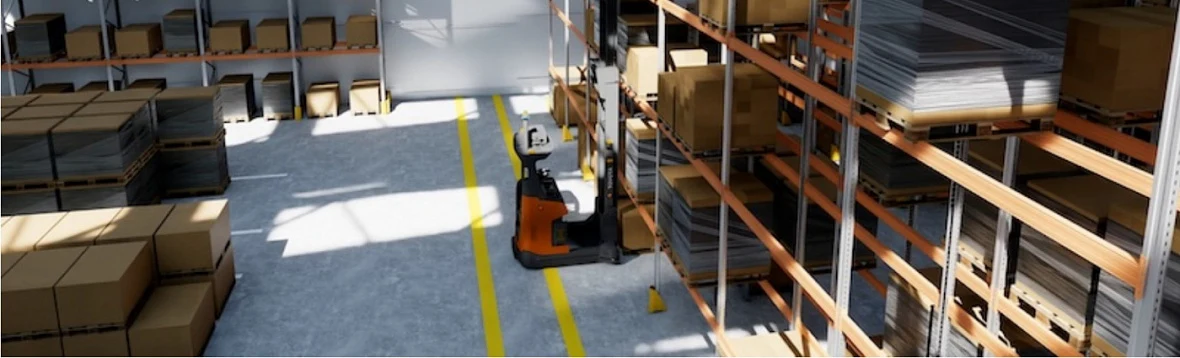
Digital twins make it possible to recreate customers' warehouses and factories. Forklift navigation, safety logic and machine behavior are checked before the equipment is sent to the site.
Simulations are also suitable for testing specific boundary scenarios. Isn't that the main thing? Forklifts work side by side with people, manual equipment and other traffic in the warehouse. All this can be tested in advance.
Toyota Material Handling notes that engineers find and solve problems earlier. This means fewer tests and adjustments will be required on site.
Machine vision training
The project also affected machine vision. Toyota trained a camera-based pallet detection system using synthetic data. They were generated through NVIDIA Omniverse libraries and enriched with NVIDIA Cosmos open world foundation models.
The result is an improvement in the object detection recall metric by more than 70%. Evaluated on real warehouse data sets.
The role of SoftServe and the concept of zero waste
SoftServe, an NVIDIA Elite Partner since 2022 and an Advanced Technology Partner since 2026, has developed a twin environment. It also integrated physical AI from NVIDIA into a simulation system for Toyota Material Handling production processes.
Olga Moroz, executive vice president and head of EMEA at SoftServe, says: the Zero Muda concept sets a clear bar - to eliminate losses before they occur, and not after.
SoftServe is proud to support the project using NVIDIA Omniverse and simulation engineering for Toyota Material Handling Europe clients. Problems are caught in the world of the digital twin long before they appear on the customer’s real forklift.
Transferring development to virtual
Toyota Material Handling is also exploring NVIDIA-powered AI vision and intelligent agents. Applications vary: quality control, predictive maintenance, process optimization and energy management.
The global task is to transfer as many stages of development, testing and commissioning as possible into the simulation. Then, during the actual installation of autonomous systems, the customer will have fewer failures.
Ernesto Dominguez, President and CEO of Toyota Material Handling Europe, emphasizes that the company's ambition is to achieve zero muda by eliminating waste that hinders the productivity of operations.
Toyota's lean thinking and automation expertise are combined with NVIDIA's physical AI platform and SoftServe's engineering capabilities. This accelerates innovation, improves the quality of solutions and helps customers achieve zero muda in their automated operations.