US restrictions target Chinese humanoid robot market access
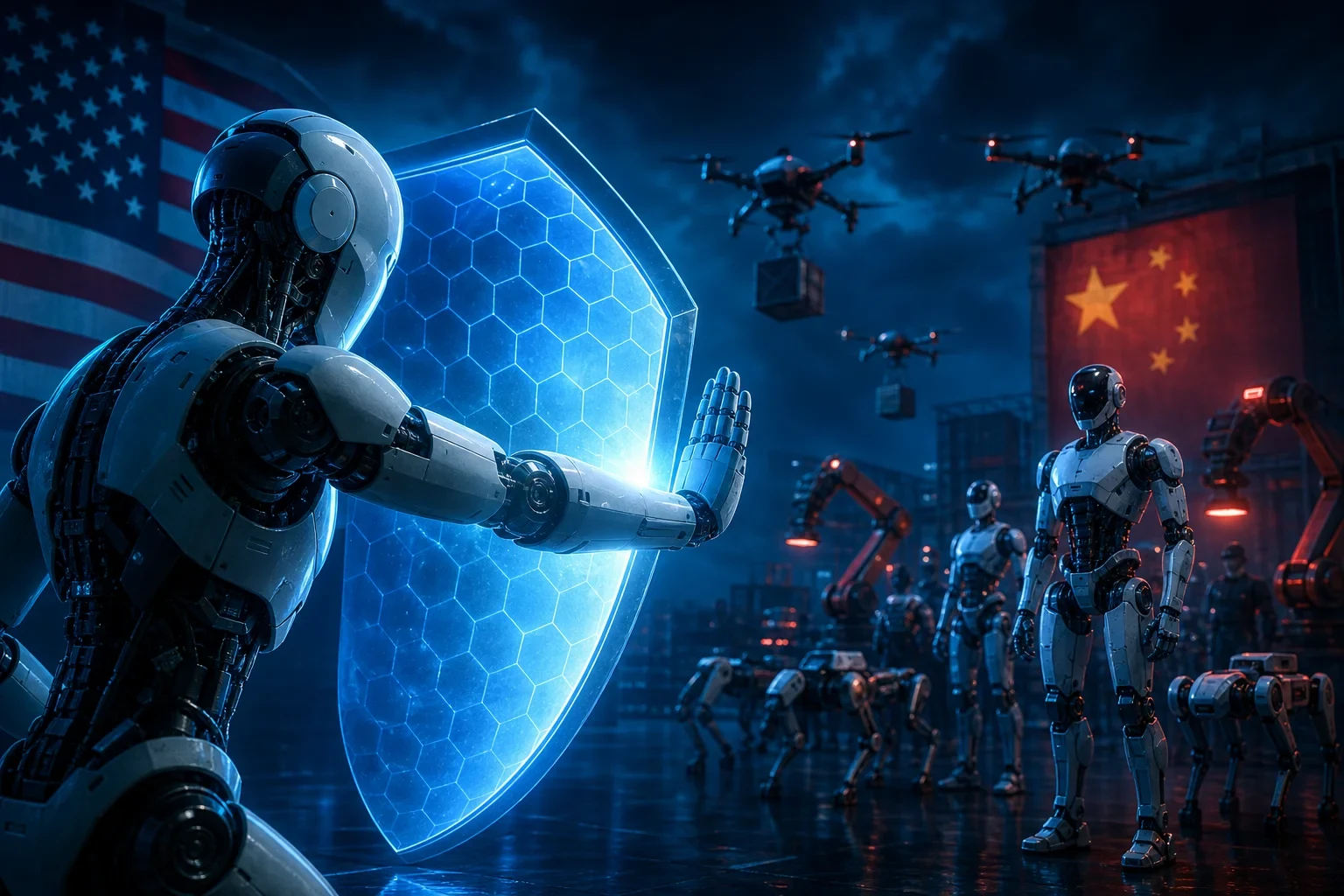
English translation from Unibot. Source published 2026-07-30.
Chinese companies account for almost 70% of the global humanoid robot market. Manufacturers from China, however, could face a serious setback in one of the world's largest technology markets.
FCC blocks certification
The US Federal Communications Commission, FCC, decided to block certification of new foreign advanced robotics equipment. The move rests on US intelligence agencies' conclusion that foreign robots pose unacceptable cybersecurity and supply-chain risks.
Already certified robots are not covered by the ban. New foreign-made humanoids, quadrupeds and other mobile robots, however, will probably be unable to obtain FCC approval. Without it, they cannot be imported, sold or used in the United States.
Analysts see this as another stage in US-China technology competition.
Expert view
Counterpoint Research senior analyst Soumen Mandal said: "Artificial intelligence is a battleground, and the battle is not easing. The Trump administration has banned sales of new Chinese humanoid robots in the US. This is unlikely to be a coincidence: several Chinese manufacturers are preparing IPOs this year. American companies, Tesla, Figure and Boston Dynamics, stand to benefit."
The restrictions continue a longstanding US policy of excluding connected technologies considered national security threats. Earlier targets included Chinese telecommunications equipment, drones, home routers and electric vehicles.
Chinese companies dominate installations
The timing is significant. Chinese companies currently lead the global humanoid robot market.
According to Counterpoint Research, AgiBot became the world's largest supplier in 2025, accounting for 31.9% of annual installations. Unitree ranked second with 26.5%. Two other Chinese manufacturers, UBTech and Leju Robot, accounted for 5.2% and 4.9% respectively.
Tesla ranked highest among US companies, with 4.7% of annual installations.
Together, four Chinese companies control almost 70% of the global humanoid robot market, illustrating how quickly China became the sector's main manufacturing base. These figures, however, reflect shares of annual installations rather than revenue or the total equipment fleet.
A growing strategic industry
Humanoid robots are increasingly described as the next major market for AI and advanced manufacturing. Technology companies are investing billions in systems that could work in warehouses, factories, logistics, inspection and healthcare, and eventually in homes.
As output grows and unit costs fall, analysts expect rapid market expansion over the next decade. This growth intensifies US-China competition. Both countries view advanced robotics as a strategically important industry.
Supporters of the FCC decision argue that connected robots can collect sensitive data, receive remote commands or introduce vulnerabilities into critical infrastructure. Critics will in turn ask whether broader industrial and economic interests are involved, especially as Chinese manufacturers strengthen their global positions.
For now, the FCC decision does not affect robots already operating in the United States. Companies and consumers will not need to replace equipment. For new foreign humanoids, however, access to the US market is now closed. It is another chapter in the accelerating race for leadership in next-generation AI-powered robotics.