What robots are already working in hotels and what awaits the hotel business in the near future
English translation from Unibot. Source published 2026-07-27.
The market offers dozens of solutions for different hotel scenarios. Here are the main types of robots that have already proven their effectiveness.
Robot concierge
Greets guests, answers standard questions, and helps with navigation around the hotel. When integrated with PMS, it can check a reservation, find a guest by last name, and participate in check-in.
Global trend: the Otonomus hotel in Las Vegas (the world's first AI hotel) has an Oto robot concierge that speaks 50 languages, remembers guests' preferences and gives personalized recommendations. In Shanghai, the Shangri-La Traders Hotel operates a humanoid robot, XMAN-R1, that greets guests, answers questions and gives welcome gifts.
Delivery robot
Delivers orders to rooms, transports luggage and cargo. Able to independently build a route, call an elevator, move between floors and notify the guest about delivery.
In Russia, a logistics rover has been developed that can transport up to 30 kg of cargo, operate for more than 6 hours and return independently to charge. He is already being considered for work in hotels.
Estimated cost: ~1.8 million rubles. (with elevator integration)
Design risk: if the elevator group, service routes and corridors are not designed for robotic delivery, the robot loses autonomy.
Washing robot cleaner
Performs maintenance wet cleaning of public areas: lobbies, corridors, conference rooms. Can work during the day or perform autonomous cleaning at night.
The C40 robot, responsible for cleaning, is already operating at Shanghai Airport.
Estimated cost: ~3 million rubles.
Project risk: the robot loses efficiency if the project has many thresholds, narrow areas, complex differences, or there is no service area for maintenance.
Robot waiter
Helps in restaurant service: transports food, drinks, dishes, unloads staff on repeating routes between the kitchen and the hall.
Estimated cost: ~1.1 million rubles.
Design risk: If a restaurant room is designed only in terms of seating and visual density, the robot will conflict with guests, waiters and furniture.
Robo-coffeepoint
It automatically prepares coffee and can work as an independent point of sale or a service element in a lobby, coworking space, or conference area.
Estimated cost: ~3.5 million rubles.
Design risk: incorrect placement in the aisle creates congestion instead of added value.
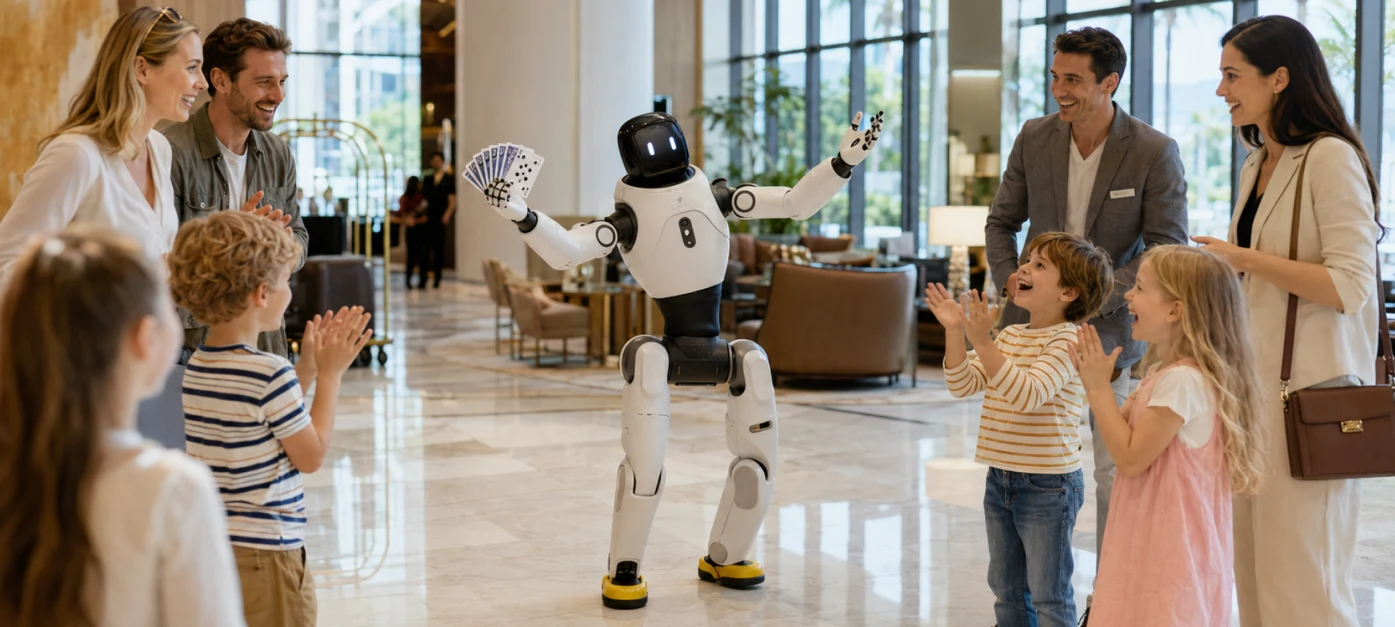
Robot animator
Creates a wow effect, greets guests, interacts with the audience, and is used in children's and family scenarios.
Estimated cost: ~7 million rubles.
Project risk: without an operational scenario, it quickly turns into an expensive toy.
APPLICABILITY MATRIX: WHAT ROBOT DOES YOUR HOTEL NEED
Robotization should not be an end in itself. Each robot must have a specific function, a clear application area, and a measurable benefit.
City business hotel
What to robotize first: reception-FAQ, delivery robot, coffee point robot
Why does this make sense: high flow of typical requests, room-service, business audience, request for speed
Resort hotel
What to robotize first: cleaning public areas, delivery, robot animator
Why it makes sense: large areas, long routes, family audience, wow effect
Aparthotel
What to robotize first: delivery, digital check-in, cleaning of common areas
Why it makes sense: Less classic service, more value in standalone scenarios
Wellness / SPA hotel
What to robotize first: navigation, cleaning, delivery
Why it makes sense: many public areas, difficult navigation, increased requirements for cleanliness
MICE hotel
What to robotize first: robot waiter, cleaning, coffee outlets
Why it makes sense: Peak loads during events, breakfasts, coffee breaks and banquets
Reconstruction
What to robotize first: selectively: cleaning, delivery, coffee point
Why it makes sense: implementation is only possible after an audit of layouts and restrictions
Main conclusion
The most important question to answer at the design stage is:
What hotel process do we want to make more manageable, faster and predictable?
If you can clearly answer this question, you are ready for robotization. If not, start there. And do this before you order your first robot.
Hotel robotization is not about purchasing equipment. This is a design solution that requires a systematic approach at the stage of architecture, engineering and BIM modeling. You can buy a robot in a month. The hotel in which it will work effectively without additional costs and restrictions must be designed in advance.
Development Systems takes robotization into account at the concept stage so that your hotel is ready for the technologies of the future - no rework, no surprises, no loss of budget.
Want to check if your project is ready for robotization?
Request an express audit
Material Creation Partner Development Systems