Wheeled humanoid robot Walden presented for work in warehouses
English translation from Unibot. Source published 2026-08-31.
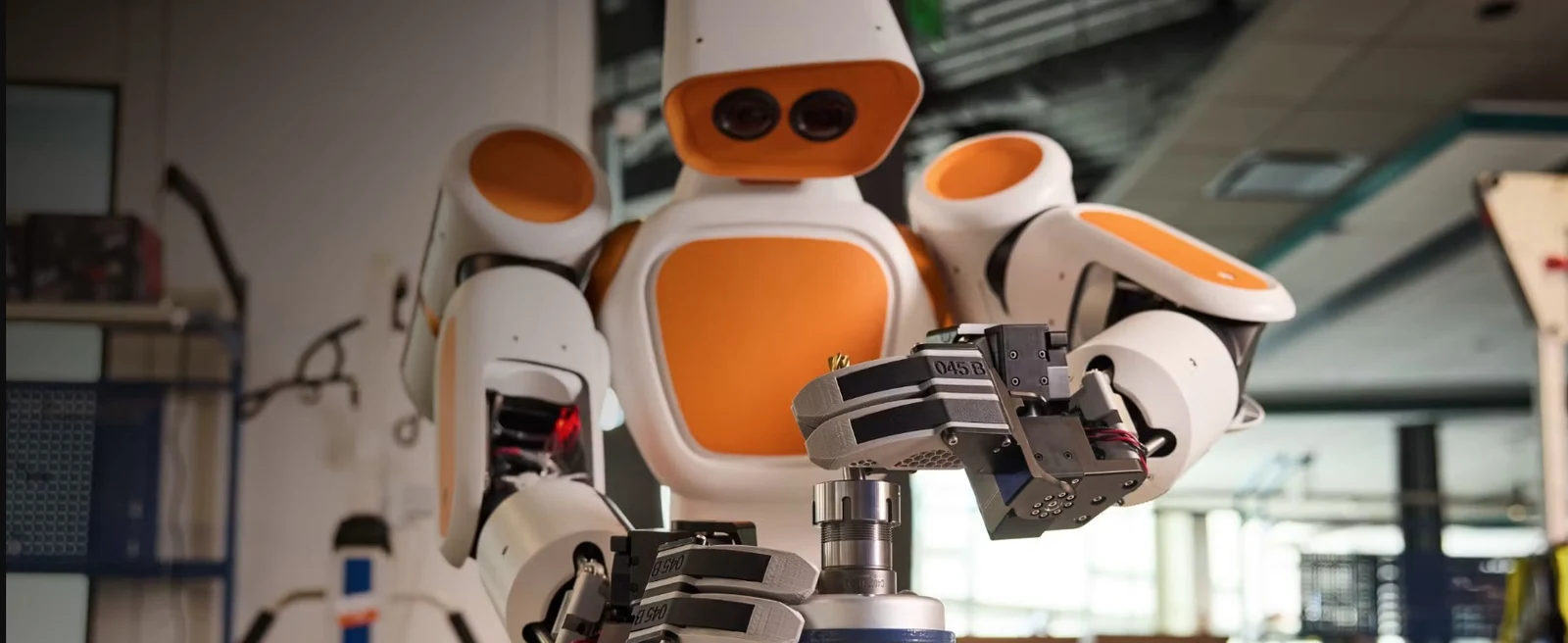
Walden Robotics has introduced a wheeled dual-arm Walden robot for factories and warehouses. Height - 165 cm, weight - 90 kg. This is a low mobile base with battery and two arms for industrial tasks.
Stability instead of a walking gait
The design prioritizes stability, safety and long-lasting performance over a striding gait. The stated battery life is four hours on a single charge, the maximum speed is 5 km/h.
Walden has 24 degrees of freedom, 12 of which are in the arms. Compact grippers are designed to last for long shifts without breaking down.
Modest estimates and bet on AI
According to the Humanoid.Guide Skill Score, the robot received 3 points out of 10 - this is the stage of active development. Navigation is rated 1 out of 5, manipulations 2 out of 5.
The figures are modest, but reflect an early practical focus on controlled indoor processes. Instead of hard programming, proprietary Large Behavior Models work here - they allow the robot to learn new tasks.
Sorting and assembly in production
Walden is designed for sorting goods and assembling products. Both functions directly fall on logistics and production. The wheelbase moves confidently on level workshop floors, and two arms work with objects and parts in stations, racks, conveyors and production areas.
Sorting covers the acceptance of goods, inventory, routing of parcels and the movement of parts between processes. Assembly expands the robot's role to manufacturing tasks where stable grip and coordinated hand movements are needed.
Grips are chosen for durability and repeatability - more important than dexterity for routine use. Training through proprietary AI models is designed to reduce the effort required to introduce new scenarios. The same platform takes on different handling and assembly tasks in an industrial environment.
Financing and first implementations
Walden is in early production and limited supply. Walden Robotics is based in Cambridge, Massachusetts, and is spun out of the Toyota Research Institute.
$300 million in funding was announced at a valuation of $1.1 billion. The round was led by Toyota and Deviation Capital, with participation from NVIDIA, Boeing and Samsung Ventures.
Walden robots are already working at the Toyota plant in North America - this is a real implementation in existing production. The focus on wheeled mobility is a deliberate strategy: to preserve the humanoid top for jobs designed for people, but to provide a stable base for reliable work in the factory.
This approach accelerates adoption in applications where uptime, safety, battery capacity, and strong grips are more important than a humanoid gait.