Why automated cutting lines are gaining ground in small furniture workshops
English translation from Unibot. Source published 2026-10-24.
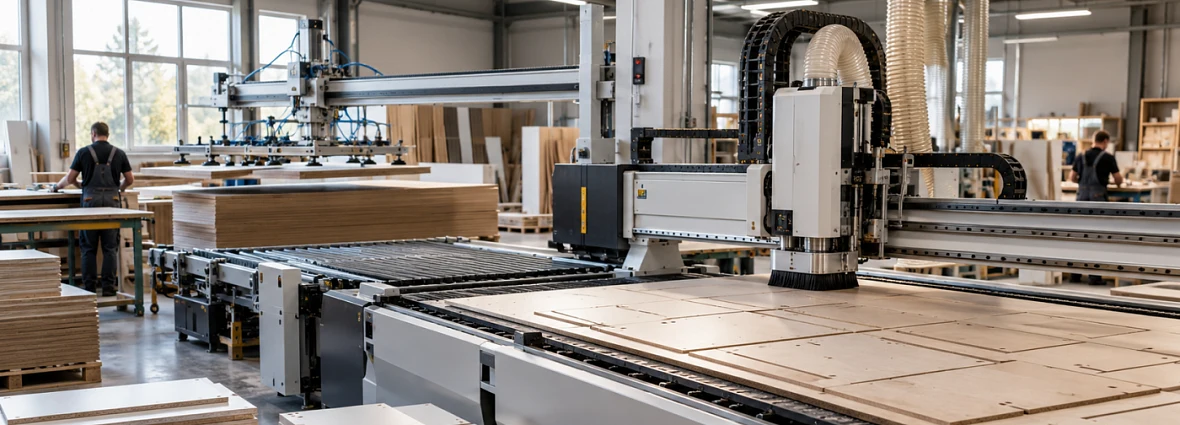
Cutting automation is not penetrating small shops for the sake of speed. It's about stability, staffing and the brutal mathematics of waste.
An overlooked staffing shortage
Skilled panel saw operators are becoming increasingly difficult to find. The Woodwork Career Alliance has been sounding the alarm for years, and workshop owners across the UK and US have been repeating the same message privately. People who read a cutting map, optimize it in their minds, and cut for eight hours straight on a machine with a carriage without a single defect, retire. And there is no replacement for them.
Automation is changing skill requirements. A person with fifteen years of experience is no longer needed. We need someone who will load a panel, follow the prompt on the screen and notice the problem if it arises. The training takes two weeks, not two years.
One workshop in Ohio with eleven employees installed a nesting router. The training time for newbies in cutting has dropped from six months to less than three weeks. Output per person increased by a third. Yes, the machine didn’t fire anyone. But it made it possible to hire people from a much wider pool.
Night shift without people
Some systems operate without personnel. I loaded the stack, set the program, and went home. An automatic cutting machine operating unattended for four hours at night gives a head start that no amount of overtime can match. And you don't need to pay a nightly rate for this.
Real money is hidden in waste
Here's a surprising number: manual cutting typically wastes 12 to 18% of each sheet. Software optimization combined with automatic cutting compresses this to 5-8%. A sheet of 18mm laminated MFC costs around £35. A workshop cutting two hundred sheets a week would waste approximately £700 of material every seven days when cutting by hand.
Halve that and you find £18,000 a year. For a small workshop, this is a significant part of the payment for the machine.
The software does what a human cannot do. It lays out parts across multiple sheets at once, takes into account the direction of the texture, plans to reuse scraps, and recalculates everything when the order changes. A smart operator can repeat this on a simple order. But on a complex one, where there are forty different sizes of parts, no one can match it.
Outsourcing as a stepping stone
Not every workshop can splash out £80,000 on a cutting machine. Many have found a middle way: they outsource the cutting, leaving the assembly and finishing themselves. Specialist suppliers offering MFC cutting to size services have grown greatly over the past five years.
The reason is simple. A small workshop receives factory cutting and edge precision without capital costs, space requirements, or dust removal upgrades. Parts arrive labeled, with precise angles and ready to assemble.
We can confidently say that this model is better suited for workshops cutting up to 100 sheets per week than their own equipment. The math changes somewhere around the 150-200 sheet mark, depending on local salary rates.
Hybrid approach
Some workshops now do both. Standard body parts are outsourced in bulk. Piece items and urgent edits are cut on site, on an old machine. Suddenly it turns out that the old machine has become a flexible reserve, rather than a bottleneck.
Automation pitfalls
Automation doesn't magically solve everything. Ask anyone who has set up a cutting line about the first three months.
Software learning curve. The optimization package is usually more difficult to master than the machine itself. Allow real learning time for this.
Data discipline. Junk cutting cards produce junk parts, only faster than before. Your design and production files should be clean.
Service response. A broken cutting machine stops everything. Check the coverage with the supplier's engineers before signing anything.
Dust and power. Many small shops need an upgrade to three-phase power and a serious dust removal system. In the business case, these costs are often forgotten.
Where is everything going?
Prices for machine tools have decreased. Basic CNC routers for cutting have become cheaper. Ten years ago they cost £60,000 and are now closer to £25,000. Used beam saws are regularly thrown onto the market from large factories that are renewing their lines.
Well, add to this software that people without an engineering degree can actually use. Plus, the labor market is increasingly narrowing. The alignment has changed.
Five years ago, small shops only thought about automatic cutting during periods of rapid growth. Nowadays, it's increasingly a way to stay afloat when things get tough. Isn't it significant?
The old panel saw is not dead. It is simply no longer the mainstay.