Worms move faster along narrow paths than along wide ones
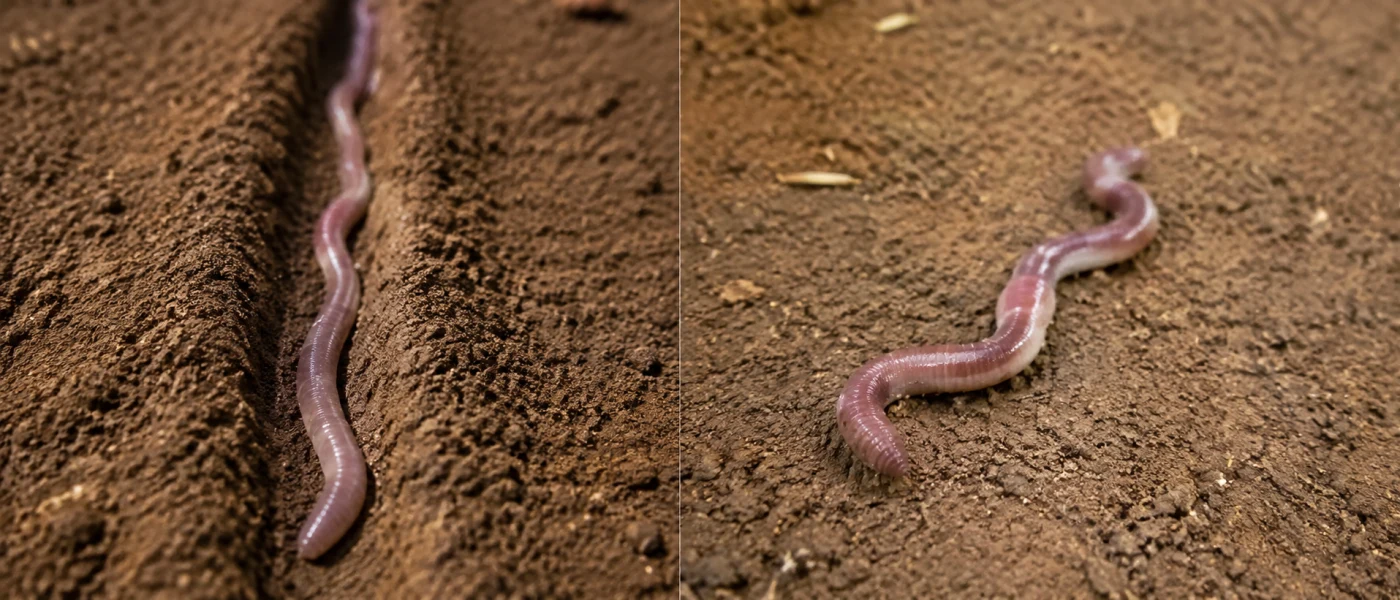
English translation from Unibot. Source published 2026-09-01.
It would seem that it could be simpler: a wide open road is always better than a narrow one. Birds soar freely in the sky, cars rush quickly along empty highways, and it is much easier to exit the building through a wide corridor.
But for many living beings, the path through open space is simply inaccessible. Whether they are burrowing in the soil or swimming through the water, they must navigate through narrow gaps in tiny pores, between rocks, roots, plants and other obstacles.
My team's recent study of California blackworms showed that sometimes the narrow path is faster. And these findings may be useful in creating specialized robots.
An unexpected question about worms
I am a physicist and study living systems. I work in the laboratory of Saad Bhamla, where we ask nature simple questions and find rich physics behind them. This work constantly takes me back to my childhood in Kerala, India. I spent hours sitting outside, watching and playing with the tiny creatures around me. Now my research gives me the same sense of wonder, only now I see the world through the eyes of a physicist.
One of the most studied organisms in our laboratory is the California blackworm Lumbriculus variegatus. These aquatic worms, several centimeters long, gather in groups and weave into tangled balls that look like a skein of thread or a bowl of noodles. Only the living ones.
In one of the projects, we studied how worm colonies behave in cramped conditions. The experiments were led by graduate student Paulami Sarkar. During the discussions, I wondered: Is it possible to build a simple computer model that captures the essence of the physics that tangles these worms into balls?
Justin Xu, an undergraduate student whom I supervised in computational research, joined the project. Together we decided to test this idea using computer simulations.
How the model works
We started with the simplest thing: we simulated the movement of one worm along two channels. The length of each channel was twice the length of the worm, but the width varied. One channel was approximately equal to the diameter of the worm, the other was much wider.
Our model is much simpler than a real worm. No muscles, no nervous system, no all the complexity of a living organism. Only two key elements: a long flexible thread and the ability to move forward.
Think of this thread as a string of tiny beads connected to each other. Now imagine that each bead carries a miniature battery that constantly pushes it along the chain. Together, these small forces cause the entire thread to bend, squirm and crawl - just like a real worm.
Because both the real worm and our model were flexible, self-propelled filaments, or “active filaments,” we could use the same physical principles to study their motion.
Then one day I noticed something unexpected. The model worm consistently crawled through the narrow channel faster than the wide one. The more I thought about it, the weirder it seemed.
Why the result is surprising
In physics, the process of movement through a limited channel or pore is called translocation. This phenomenon has been studied in detail using the example of long flexible molecules - polymers. The most famous example is DNA.
DNA is a long, thread-like molecule that often passes through tiny pores in biological membranes, both inside living cells and in modern sequencing technologies. Narrow DNA pores have less room for DNA to bend and change shape, so tighter confinement tends to slow down its movement.
California blackworms, however, are nothing like DNA. They continuously move forward, contracting and bending their long flexible bodies. In physics, such systems are called active matter. Active matter includes swimming bacteria, migrating cells, flocks of birds, schools of fish, and self-propelled robots.
The unexpected result of computer modeling raised a whole series of questions. Was this simply an artifact of our computational model, or did the California worm actually move faster through narrower passages? And if DNA slows down in narrow pores, then why do active strands behave so differently in confined spaces?
Testing for live worms
There was only one way to find out: test the idea on real California blackworms. I shared the unexpected simulation result with Sarkar and Bhamla, and they were equally excited and intrigued. Sarkar designed a series of experiments with worms in canals that were 12 centimeters (about 5 inches) long, about twice the length of the worm. She varied the width of the canals from 1 to 8 millimeters, which is approximately 2 to 16 times the diameter of the worm (the diameter is about half a millimeter).
To our surprise, experiments with real worms told the same story. Like their simulated counterparts, the worms consistently moved faster through narrower channels than through wider ones. For the channel length we tested, it took them almost three times longer to get out of wide channels than from narrow ones.
What started as a surprising observation in a simple computational model has now been confirmed in a living organism.
Experiments and simulations tell the same story
Inside the narrow channel, the active filaments had almost no opportunity to turn to the side. The surrounding walls naturally kept their bodies aligned with the direction of travel, so they spent most of their time moving towards the exit rather than changing direction.
The wider channel gave them more room to maneuver, so they often stopped, twisted, reoriented, and explored lateral directions before continuing on. Such stops and restarts became increasingly frequent as the canal expanded.
Greater freedom of movement, it turned out, had a hidden price. Every pause, bend and change of direction delayed progress. Instead of helping to get to the exit faster, the extra space encouraged exploratory behavior.
From active threads to flexible machines
The implications of our findings extend far beyond worms. Engineers face similar challenges when designing flexible machines. Scientists are developing soft robots: machines made of soft, flexible materials that can bend and move like worms. These robots must navigate tight spaces while remaining flexible enough to avoid damage. The obvious engineering solution is often to remove obstacles and create more space.
Our results offer an unexpected insight: constraint does not always impede movement. For soft robots, narrower paths can sometimes be an advantage, helping future machines navigate tight spaces - whether delivering drugs or minimally invasive procedures inside the human body, or inspecting hard-to-reach sections of industrial pipelines.
In research, we typically select questions we want to answer and spend months, sometimes years, searching for the answers. But from time to time the opposite happens. An unexpected observation sparks curiosity and inspires us to stop and ask: why?
One of the joys of science is discovering that nature often challenges our intuitions.