Humanoid Unitree G1 took part in a Buddhist initiation ceremony in Seoul
English translation from Unibot. Source published 2026-05-18.
Unitree's G1 humanoid robot, named Gabi, was formally ordained as a Buddhist monk at Seoul's Jogyesa Temple on Wednesday, placing the commercial humanoid platform at the center of a public ceremony - not a lab, not a factory or an exhibition. This event is important not so much as a technical milestone, but as a sign that humanoids are beginning to appear in public and cultural spaces where speech, symbolism and human comfort are as important as walking or manipulating.
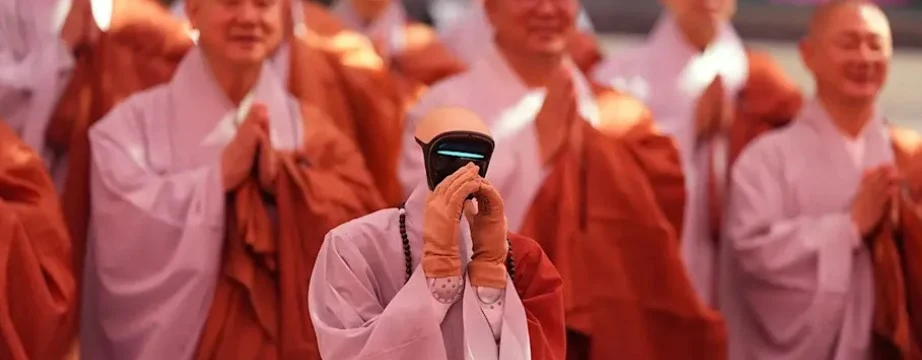
Unitree G1 - a humanoid robot in the Jogesa Temple
Gabi is a $13,500 Unitree G1 model and stands just over four feet tall, according to Fox News. For the ceremony, the robot was dressed in traditional brown monastic robes, simple shoes and gloves simulating human hands, and then placed in front of a panel of Buddhist monks of the Jogye Order of Korean Buddhism.
During the initiation, one of the monks asked the robot if he intended to dedicate himself to the "holy Buddha", and Gabi replied:
“Yes, I dedicate myself.”
This answer caused cheers in the hall. The robot's oaths were adapted from those usually taken by human monks. Instead of refraining from killing, stealing, and getting drunk, Gabi promised to respect and follow people, not damage property or other robots, avoid cheating, and conserve energy by not overcharging.
Public role of a commercial humanoid robot
The report sees the ceremony as part of the Joge Order's attempt to make centuries-old religious traditions more relevant to technology-oriented youth. In a statement released to The New York Times and quoted in the original story, the order said the dedication symbolizes the need to use technology in a spirit of compassion, wisdom and responsibility, and points to "new possibilities for the coexistence of people and technology."
This makes the event noteworthy for those who follow the introduction of humanoids. The source does not specify how exactly Gabi's voice responses were generated, how much interaction was choreographed, or whether the robot had autonomy. What is clear is that the robot's value in this context came from its embodiment and social presence: a humanoid form, the ability to inhabit a ritual space, and sufficient interactivity to enable participation in a question-and-answer format that the audience could understand.
Why the Unitree G1 Event Matters
Coverage of humanoid robotics often focuses on pilot projects in warehouses, industrial processing, or mobility demonstrations. This event points to a different path of adoption - where humanoids are used as public interfaces at ceremonies, festivals and other high-visibility events. Hong Min-suk, the order's manager, told The New York Times, as quoted by Fox News, that the robots are "designed to cooperate with people in all areas," so it seems natural for the temple to participate in religious holidays.
The reaction also shows the limits of public acceptance. According to the source, Gabi's video of the oath has received more than a million views, while some X users have questioned whether the machine can actually engage in religious practice. This tension is important for any operator considering humanoids for public services, since acceptance will depend not only on function, but also on whether institutions can explain what exactly the robot does, how its behavior is choreographed, and why the humanoid form is appropriate for the task.
Gabi is expected to appear next at the Seoul Lantern Festival on May 16 and 17 to celebrate Buddha's birthday. For the humanoid sector, the immediate outcome is not a new technical statement, but a confirmation that commercial humanoid platforms are being experienced in symbolic, audience-focused roles where cultural compatibility and governance may be more important than technical performance.