Unitree G1 robots performed surgery on a pig
English translation from Unibot. Source published 2026-07-13.
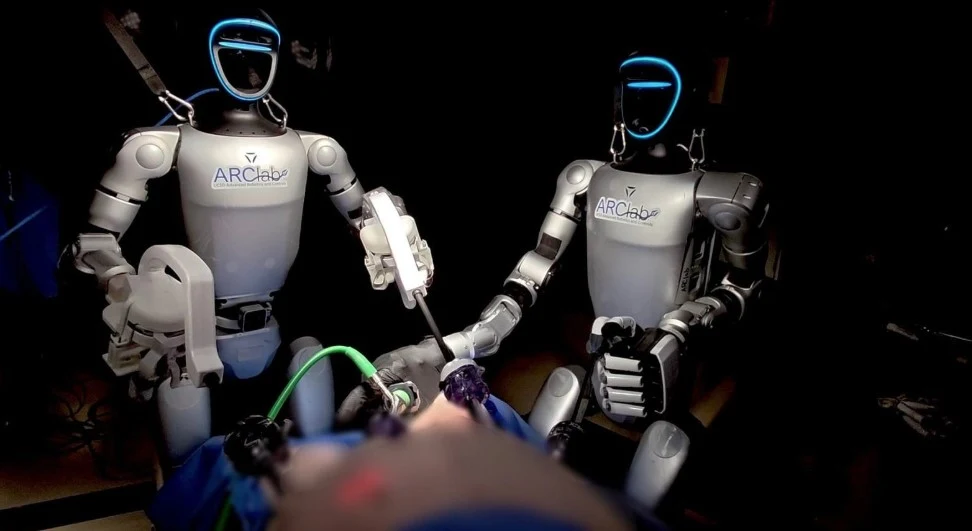
Researchers at the University of California, San Diego used two Unitree G1 teleoperated humanoid robots to perform laparoscopic gallbladder removal in a live pig, Forbes reports. The robots performed surgical steps such as tissue retraction, dissection, clipping and removal of the gallbladder from the liver bed.
The statement is modest, but significant. This was not a stand-alone operation, and it was not performed on a person. Trained surgeons were in full control of the robots, and the machines were tethered with cables to prevent them from falling into the operating area.
Even with these caveats, the work places a mass-produced humanoid platform in one of the most challenging environments to manipulate.
Standard robots in the operating room
The San Diego team, which included researchers from the medical school and the university's ARClab, did not create a dedicated surgical robot for the experiment. Forbes reports that the group used two Unitree G1s - small platforms approximately 1.2 to 1.5 meters high and weighing about 32 kilograms, available for less than $20,000.
The article states that the particular robots likely used Unitree Dex3 dexterous hands with a thumb, index and middle fingers and multiple articulated joints. It also points to additional wrist and waist articulation, as well as 3D LiDAR and a depth camera as appropriate hardware for operating instruments and interacting with the surgical scene.
The benchmark in this area is not another humanoid robot. This is the da Vinci system from Intuitive Surgical, a stationary surgical robot installed in thousands of operating rooms and designed for minimally invasive procedures.
A humanoid robot is a less specialized tool, but it is built on a different premise: working in an environment designed for humans, with tools and processes originally designed for humans.
Still far from clinical use
The researchers presented the work as an assessment of whether humanoid robots could expand medical care where surgeons are not physically present. In an overview of their project cited by Forbes, the team wrote: “Human-like form factors offer unique potential, especially to assist in surgical tasks.”
They also noted that it remains unclear how close current humanoid systems are to the precision, control and safety requirements of minimally invasive surgery.
The Nature article cited by Forbes said that "key technical challenges" remain before clinical application. This is a practical reading of the result. G1 performed an actual surgical procedure on living tissue, but only under close human supervision and with physical safety precautions.
For robotics, the useful signal is not that a cheap bipedal robot is ready to replace the surgical platform. It is that a conventional humanoid robot with suitable arms and telecontrol can manipulate surgical instruments well enough to perform a specific laparoscopic procedure in an animal study.
An open question for operators and researchers is whether this ability can be made reproducible, safe and sufficiently accurate outside of a controlled experiment.