Unitree presents UnifoLM OminiA unified model for G1 humanoid
English translation from Unibot. Source published 2026-08-04.
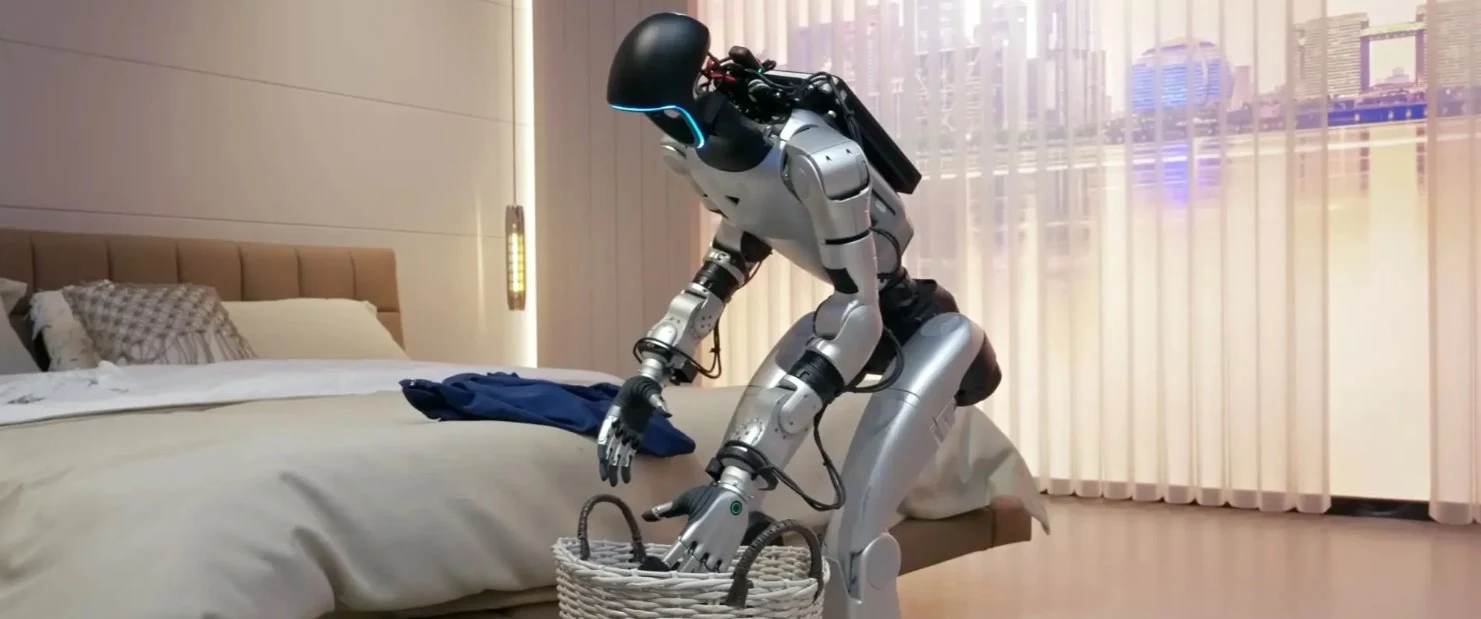
Unitree Robotics presented UnifoLM OminiA, a unified "brain" model for its G1 humanoid. Rather than separate modules, it combines hearing, vision, reasoning and control in one system. The robot hears a request, sees the scene and follows the entire task sequence.
This approach supports more natural behavior in homes, where routines change and interruptions are common.
A focus on practical assistance
Unitree emphasizes domestic scenarios: tidying a room, sorting laundry, organizing shelves, loading a dishwasher, straightening a bed and recognizing medicine packaging. The model's Brain Score is 8, corresponding to a state-of-the-art level.
The company targets adaptive embodied intelligence: a general software stack intended to make assistance smoother, more contextual and more useful at home rather than a narrowly scripted demonstration.
Unified multimodal processing
The central technical feature is one model processing speech, visual scenes, task reasoning and action selection within a shared environment. This reduces switching between separate programs and preserves context from beginning to end.
That is important for home care and wellness scenarios where a request depends on room layout, object locations and changing conditions around a person or bed. The model listens to spoken instructions, tracks environmental changes and maintains the task's thread.
This architecture is relevant to both older-person support and hospital assistance. Reliability, adaptability and calm recovery from failures matter more there than narrow benchmarks. The result is a shared embodied intelligence layer rather than isolated skills.
Availability and strategy
UnifoLM OminiA is available by arrangement. Unitree calls it a step toward practical everyday robot assistants rather than a finished mass-market product. It belongs to the UnifoLM family, connecting this release to the company's longer-term embodied AI strategy, including world-model and general manipulation research.
Public code and weights are not available for this version. The company retains control over deployment and iteration.
The model's value is not immediate developer access but the direction it signals: the next phase of humanoid software involves integrated brains targeting real home care, health support and structured service environments, where adaptability matters as much as task execution.